NVIDIA GeForce GTX 1080 Ti Benchmark: FPS and In-Game Performance
Reference CPU: Intel Core i5-13400
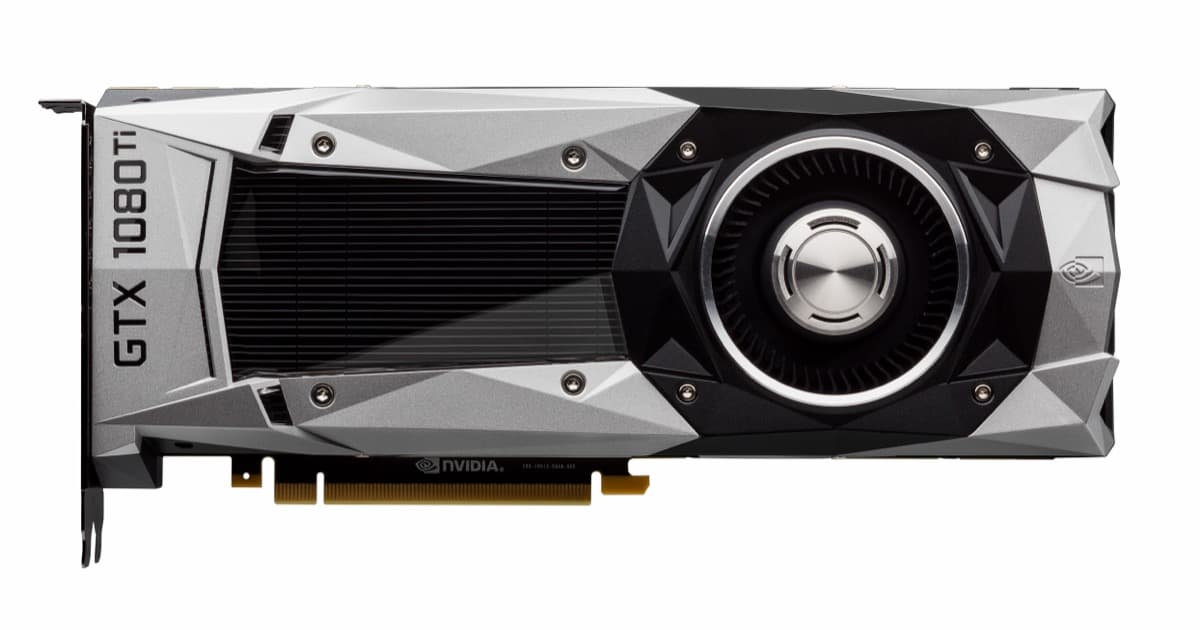
The NVIDIA GeForce GTX 1080 Ti is the NVIDIA graphics card we cover on this page. Here you'll find its real gaming performance — average FPS (frames per second) across the 20 most popular games at 1080p, 1440p (2K) and 4K (UHD) — its uplift with AI upscaling (DLSS/FSR/XeSS), key specs such as its 11 GB of VRAM, and comparisons with similar GPUs. All figures are estimates from our engine on a reference CPU.
Performance Scores
NVIDIA GeForce GTX 1080 Ti Full Specifications
Official manufacturer specifications for the NVIDIA GeForce GTX 1080 Ti.
| Brand | NVIDIA |
| VRAM | 11 GB |
| Power Draw (TDP) | 250W |
| Tier | High-end |
| Release Year | 2017 |
| Architecture | Pascal |
| Process Node | TSMC 16nm |
| Shading Units (CUDA/Stream) | 3584 |
| Texture Units (TMUs) | 224 |
| ROPs | 88 |
| Base Clock | 1480 MHz |
| Boost Clock | 1582 MHz |
| FP32 Performance (Teraflops) | 11.34 TFLOPS |
| PassMark (G3D Mark) | 18,592 |
| Memory Type | GDDR5X |
| Memory Clock | 11000 MHz |
| Memory Bus | 352-bit |
| Memory Bandwidth | 484 GB/s |
| PCIe Version | PCIe 3.0 |
| Transistor Count | 11.8B |
| Release Date | 2017-03-10 |
Average gaming performance (2026)
The NVIDIA GeForce GTX 1080 Ti averages 46 FPS at 1080p Ultra, 35 at 1440p and 19 at 4K across the 20 most popular games (estimated). Built for 1080p; in demanding games, lowering quality or enabling upscaling helps.
What FPS does the NVIDIA GeForce GTX 1080 Ti get in your game?
Pick a game and we'll take you straight to its real FPS on this GPU.
FPS in Popular Games
| Game | 1080p | 1440p | 4K | Rating |
|---|---|---|---|---|
Warhammer 40,000: Dawn of War IV | 56 | 43 | 23 | Acceptable |
Star Wars Zero Company | 56 | 43 | 23 | Acceptable |
Grand Theft Auto IV: Complete Edition | 50 | 39 | 21 | Acceptable |
Kena: Scars of Kosmora | 50 | 39 | 21 | Acceptable |
Ace Combat 8: Wings of Theve | 50 | 39 | 21 | Acceptable |
Silent Hill: Townfall | 50 | 39 | 21 | Acceptable |
Halloween: The Game | 48 | 37 | 20 | Acceptable |
Clive Barker's Hellraiser: Revival | 48 | 37 | 20 | Acceptable |
The Sinking City 2 | 48 | 37 | 20 | Acceptable |
Guild Wars 3 | 46 | 36 | 19 | Acceptable |
Mortal Shell II | 45 | 35 | 18 | Acceptable |
Valor Mortis | 45 | 35 | 18 | Acceptable |
Final Fantasy Resonance | 43 | 34 | 18 | Acceptable |
Aion 2 | 43 | 34 | 18 | Acceptable |
Final Fantasy VII Revelation | 40 | 31 | 17 | Acceptable |
Lords of the Fallen II | 40 | 31 | 17 | Acceptable |
Alien: Isolation 2 | 39 | 30 | 16 | Acceptable |
| Grand Theft Auto VI | 39 | 30 | 16 | Acceptable |
Atomic Heart 2 | 37 | 29 | 15 | Acceptable |
Control Resonant | 37 | 29 | 15 | Acceptable |
Performance with AI upscaling
Estimated average FPS with FSR enabled, which renders at a lower resolution and reconstructs the image for more frames. Quality and Performance modes trade sharpness for FPS differently.
| Resolution | Native | FSR Quality | FSR Performance |
|---|---|---|---|
| 1080p | 46 | 58 | 67 |
| 1440p | 35 | 47 | 58 |
| 4K | 19 | 28 | 35 |
Estimated values. The real gain varies by game and by how the technology is implemented.
Best CPU for the NVIDIA GeForce GTX 1080 Ti & bottleneck
The CPU you pair with the NVIDIA GeForce GTX 1080 Ti matters mostly at 1080p; at 1440p and 4K the graphics card itself sets the pace (you are GPU-bound) and the processor is almost irrelevant.
A AMD Ryzen 5 5600 already gets the most out of the NVIDIA GeForce GTX 1080 Ti with no bottleneck. Moving to a pricier processor barely adds frames.
NVIDIA GeForce GTX 1080 Ti FPS with different CPUs
| Processor (CPU) | 1080p | 1440p | 4K |
|---|---|---|---|
| AMD Ryzen 5 5600Sweet spot | 45 | 35 | 19 |
| Intel Core i5-12400 | 46 | 35 | 19 |
| AMD Ryzen 7 7800X3D | 46 | 35 | 19 |
| Intel Core i9-14900K | 46 | 35 | 19 |
Will your CPU bottleneck the NVIDIA GeForce GTX 1080 Ti?
At 1440p and 4K there is no bottleneck: the NVIDIA GeForce GTX 1080 Ti is the limiting component, so any decent modern CPU performs the same. At 1080p a weak processor can hold back a few frames in CPU-heavy games (strategy, simulation or AI-heavy open worlds). As a rule of thumb, a fairly recent 6-core CPU avoids bottlenecking this card.
Frequently asked questions
Is the NVIDIA GeForce GTX 1080 Ti good for 1080p, 1440p and 4K?
At 1080p Ultra it averages around 46 FPS; at 1440p (2K) it drops to 35 FPS and at 4K (UHD) to 19 FPS across the most popular games. At higher resolutions, enabling upscaling (DLSS/FSR) helps restore smoothness.
How many FPS (frames per second) are enough?
30 FPS is the playable minimum, 60 FPS the comfortable standard, and 120-144+ FPS ideal for high-refresh monitors or competitive play. In the tables the colour shows the level: green 120+, blue 60+, amber 30+ and red below.
Ultra vs High quality: is it worth it?
Dropping from Ultra to High is barely noticeable yet usually raises FPS by 15-25%. If you want more performance from the NVIDIA GeForce GTX 1080 Ti, High quality is almost always the best balance of sharpness and smoothness.
Will the CPU bottleneck the NVIDIA GeForce GTX 1080 Ti?
It depends on the processor and resolution. At 1080p the CPU matters more and an older CPU can bottleneck; at 1440p and 4K the graphics card leads. These figures use a balanced reference CPU.
How much VRAM does the NVIDIA GeForce GTX 1080 Ti have, and is it enough?
The NVIDIA GeForce GTX 1080 Ti has 11 GB of VRAM (video memory). As a guide, 8 GB is the practical minimum for 1080p, 12 GB is recommended for 1440p, and 16 GB or more for 4K and the games of the coming years.
What does the NVIDIA GeForce GTX 1080 Ti score in PassMark, 3DMark, or TFLOPS?
In the spec table above we show its PassMark (G3D Mark) score and TFLOPS as a reference for raw power. But what we really measure at CheckFPS is real in-game FPS across popular titles —what you'll actually notice while playing— not a synthetic score: a high 3DMark number doesn't always mean more frames in your game. That's why the gaming performance you see comes from our own FPS engine.